Finally getting around to seeing Olivia Wilde’s third directorial effort, The Invite, feels a little like checking in on a filmmaker who needed a reset. Her previous film, Don’t Worry Darling, was such a dismal follow-up to her terrific debut, Booksmart, that its 2022 theatrical release became almost inseparable from the bizarre press tour that surrounded it. Between the awkward body language, the infamous possibility of Harry Styles spitting on Chris Pine (?), and Wilde’s rocky romantic fling with Styles overshadowing the movie itself, it briefly seemed as though her meteoric rise as a director was about to experience an equally spectacular crash landing. Thankfully, The Invite is a welcome return to form, scaling things down considerably and putting Wilde back in the kind of comedic territory where she seems most comfortable.
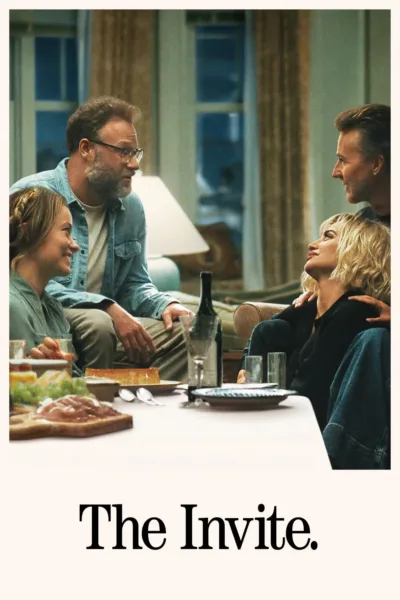
Essentially a play, the film takes place almost entirely inside one apartment, features just four principal characters, and unfolds over the course of a single eventful evening. It’s a smart move for Wilde, who gives herself a much leaner production through which to demonstrate her strengths as a director. The story follows two couples at very different stages of their relationships. Angela (Wilde) and Joe (Seth Rogen) have been married for years and have a daughter together, but their marriage has been on life support for some time. They stay together for the sake of their child, though they barely acknowledge one another outside of their frequent bickering. Neither feels particularly fulfilled, and as we learn toward the end of the film, it’s been an entire year since they last had sex.
Their upstairs neighbors, meanwhile, seem to be having considerably more fun. Angela and Joe are frequently subjected to the sounds of their neighbors having loud sex through the ceiling, and Angela eventually decides to invite them over for dinner, hoping to figure out what makes their relationship tick and whether some of that spark might rub off on her own marriage. Joe, naturally, has little interest in befriending the people responsible for disrupting his peace. He doesn’t even know about the dinner party until roughly ten minutes before the guests arrive, setting the stage for an evening that begins with considerably less hospitality than Angela might have hoped for.
Enter Pina (Penélope Cruz) and Hawk (Edward Norton), a couple whose presence immediately changes the atmosphere of the apartment. Joe’s greeting is blunt and uninviting, while Angela is practically bursting with the desire to impress their guests and convince everyone that this is going to be a pleasant evening. It doesn’t take long for the conversation to become a minefield of passive-aggressive remarks, awkward personal revelations, and increasingly pointed questions about what makes a relationship work. Wilde and co-screenwriters Will McCormack and Rashida Jones give the dialogue a snappy, occasionally head-spinning rhythm, with all four characters frequently talking over one another in the cramped confines of the apartment. There’s a Sorkin-like quality to the back-and-forth, though the film’s energy comes less from intellectual grandstanding than from the sense that any given conversation could spiral into something deeply uncomfortable at a moment’s notice.
The cast is a major reason why it all works. Rogen brings his familiar brand of stoner-like awkwardness to Joe, a man who would much rather be left alone than participate in the evening’s social experiment. Wilde plays Angela as someone desperately trying to keep the night afloat, constantly searching for approval and hoping that her guests might offer some insight into the relationship she can no longer seem to repair. There’s a palpable desperation to her attempts to impress Pina and Hawk, and Wilde does a nice job balancing that neediness with the frustration of someone who knows her marriage is falling apart but isn’t quite ready to admit what that means.
Norton, meanwhile, gives a slippery performance as Hawk. He’s pleasant enough on the surface, but there’s a shyness around the personal details of his life that makes it difficult to determine whether he’s simply reserved or deliberately withholding something. And then there’s Cruz, who arrives like a hurricane and immediately threatens to blow apart whatever fragile social niceties remain in the room. Pina is confrontational, blunt, and seemingly incapable of letting an uncomfortable subject go, particularly when it comes to identifying the source of Angela and Joe’s discontent. Cruz is a terrific presence here, injecting the film with an unpredictability that keeps the other three characters constantly on edge.
What I appreciate most about The Invite is how effectively Wilde uses the confined setting to build tension and comedy without letting the film feel static. The premise is straightforward, but the evening’s escalating absurdity gives the story enough momentum to remain consistently engaging. The script knows how to move between humor and genuine relationship drama, and the performances make even the more ludicrous developments feel grounded in the characters’ insecurities and frustrations. It’s a film about intimacy, sexual dissatisfaction, and the ways couples can become so accustomed to their own unhappiness that they need to look at someone else’s relationship to understand their own. The dinner party might be an increasingly ridiculous means of getting there, but the emotional territory is recognizable.
That said, the film’s theatrical construction does occasionally make itself apparent. With four people talking in a relatively confined space for most of the runtime, the dialogue and performances have to do nearly all the heavy lifting. Fortunately, the cast is more than capable of keeping things lively, and the pacing rarely gives the film much opportunity to grow stale. I wouldn’t necessarily call The Invite a groundbreaking comedy or a particularly radical examination of relationships, but it doesn’t need to be. Its success lies in how well it executes a familiar setup, allowing four talented actors to bounce off one another until the evening becomes impossible to control.
READ MORE MOVIE REVIEWS: Making Marie Antoinette, The Cycle, You Can See Everything
After the misfire that was Don’t Worry Darling, The Invite feels like a reminder of where Wilde’s talents as a director are best put to use. I think she’s much more in her lane with these smaller-scale, character-driven comedies, and this film benefits from having a more seasoned ensemble than the high school comedy of Booksmart. The cast is excellent, the dialogue is sharp, and the events of this ludicrous night are paced just well enough to keep you hooked.
Score: 7/10
Movie Details
The Invite (2026)
- Released
- Runtime
- 1 hr 47 min · 107 minutes
- Rated
- Director
- Olivia Wilde
- Studio
- A24