In the year of our Lord 2026, satire has become an increasingly difficult genre to pull off, in part because the world already feels like it’s become a satire of itself. Political and cultural headlines grow more absurd by the day, and capturing a heightened version of that reality is a challenge in its own right. But it’s one thing to create an authentic and original portrait of the insanity surrounding us, and another to find a cutting message underneath it all that doesn’t feel heavy-handed while still making its point crystal clear. It’s a tricky balance, and one that plenty of filmmakers seem to be struggling with lately.
Of all the places I’d expect a searing, worthwhile doomsday satire to emerge, Netflix would probably be near the bottom of my list. The streaming service has become synonymous with safe, washed-out storytelling, regurgitated genre tropes, and projects designed to appeal to the widest possible audience at an affordable production cost. Even some of the industry’s more astute filmmakers are falling back on remaking classic works barely a year after someone else has already taken a crack at the same material (see Ben Affleck’s Animals). Netflix isn’t exactly the first name that comes to mind when I’m looking for daring original ideas. But every once in a while, the service acquires a film out of the festival circuit that tries to test those boundaries, and Romain Gavras’ Sacrifice is one such attempt.
Following 2022’s Athena, Gavras returns to Netflix with a bigger budget and a starrier cast for a satire about celebrity, wealth, climate catastrophe, and the lengths people are willing to go to save a world they’ve helped destroy. Chris Evans gives one of his more self-reflexive and accomplished performances in recent memory as Mike Tyler, an A-list actor experiencing an existential crisis alongside a public image that’s rapidly deteriorating. Desperate for a viral moment that might revive his career, Mike tries to manufacture one at a charity gala ostensibly devoted to environmental health, interrupting the evening’s proceedings to point out the hypocrisy of hosting such an event inside a drilled-out cave system. It’s the kind of publicity stunt that seems designed to make him look like a man willing to speak truth to power, but the empty speeches and self-righteous billionaires surrounding him aren’t exactly receptive to the criticism.
Among them is Ben Bracken (Vincent Cassel), the world’s richest man, whose familiar combination of smugness and villainy makes him a fitting representative of the ultra-wealthy elite. But beneath the performative philanthropy and hollow declarations of goodwill, something considerably more sinister is brewing. A radical zealot named Joan (Anya Taylor-Joy) has assembled a group of followers who believe that saving the world requires three sacrifices. As the evening descends into chaos, Joan becomes fixated on Mike and the heroic persona the other celebrities have conveniently constructed around him. Rather than volunteer themselves for the cause, the gala’s privileged guests see an opportunity to offer up someone else. Mike becomes an uneasy intermediary between Joan’s increasingly violent movement and the outside world, caught between the public image he’s spent his career cultivating and the terrifying reality of what that image might now demand of him.
What makes Sacrifice somewhat more interesting than your average celebrity satire is that, for much of its runtime, it isn’t particularly interested in being funny. The characters are exaggerated versions of familiar celebrity and billionaire archetypes, or at least I hope they’re exaggerated, but Gavras isn’t simply trying to turn contemporary cultural figures into punchlines. There’s a more existential anxiety running through the film, a sense of desperation about the future of the planet and the responsibility that those with the financial means to change its trajectory have in preserving it for generations to come. The central conflict becomes a grotesque expression of a question that hangs over the entire movie: if the world is hurtling toward catastrophe, what are we actually willing to give up to prevent it?
There’s something to appreciate in that approach, and I liked Sacrifice decently enough, even if I never quite fell in love with it. Evans is very good as an actor whose desperation to reclaim his career collides with the possibility that he might finally be asked to stand for something beyond his own self-interest. Taylor-Joy, meanwhile, brings a physicality and conviction to Joan that makes her more than just another eccentric doomsday prophet. Her character’s radicalization feels rooted in an upbringing and worldview that have led her to embrace a horrifyingly absolute belief: that the world can only be cleansed through sacrifice. The performances give the film a tangible sense of conflict, and there are stretches where its mix of celebrity vanity, apocalyptic dread, and moral grandstanding comes together quite effectively.
But the longer Sacrifice goes on, the more its ideas begin to feel familiar. There are obvious thematic and tonal similarities to the work of Ruben Östlund, a filmmaker whose movies I’ve never been particularly fond of, even if The Square and Triangle of Sadness have managed to linger in the cultural conversation thanks in part to their awards-season visibility. Gavras is working in a similar lane, using wealthy and self-absorbed characters to expose the absurdity of social hierarchies and the performative nature of supposedly moral behavior. Yet the film never quite develops its premise into something that feels as incisive as it wants to be. The initial setup offers plenty of possibilities, but the further we get into the chaos, the more the movie runs out of steam, leaning on the same familiar criticisms without finding enough new ways to complicate them.
There’s also the uncomfortable contradiction at the heart of these kinds of projects. Sacrifice is a film about the wealthy, powerful, and culturally influential failing to take meaningful responsibility for the world’s problems, made by some of the very people who benefit from that system and distributed by one of the most powerful entertainment companies on the planet. Hollywood loves to champion stories about society’s failures, climate catastrophe, and the moral bankruptcy of the ultra-rich, but how often is it willing to turn that same scrutiny inward? Instead, these films can begin to feel like a form of spiritual cleansing, a way for the industry to acknowledge its complicity and then congratulate itself for having the courage to acknowledge it. Make a movie about the problem, collect the applause, and carry on as before.
Of course, you could make that argument about practically all art. Movies can raise awareness, provoke discussion, and serve as acts of protest without single-handedly solving the problems they depict. I don’t expect every film to produce meaningful political change, nor do I think an artist’s participation in an imperfect system automatically invalidates their work. But there’s a point at which watching the same cultural anxieties get recycled into another high-profile satire starts to produce an eyeroll. If the message remains largely unchanged from one film to the next, and the people making those films are rarely willing to meaningfully interrogate their own position within the system, then what exactly are we supposed to take away from another round of wealthy people behaving terribly while the world burns?
That frustration ultimately keeps Sacrifice at arm’s length for me. This isn’t a deeply unfunny, boring, or poorly acted film, and I appreciate that Gavras is at least attempting something with a little more bite than the usual Netflix offering. Evans and Taylor-Joy are both compelling, the premise has some genuinely provocative implications, and the film occasionally finds a productive tension between its absurdity and its more serious concerns. But it never quite develops those ingredients into a satire that feels particularly fresh or essential. Like so many films of this ilk, it understands that the world is in trouble and that the people with the greatest power to change things are often the least willing to do so. What it struggles to articulate is anything beyond that familiar observation.
READ MORE MOVIE REVIEWS: V/H/S/Mixtape, Late Fame, The Social Reckoning
Maybe that’s an unfair standard to hold satire to in a world where the headlines are already doing half the work. But if filmmakers are going to keep turning the world’s most pressing problems into cinematic spectacle, I’d like to see them do more than simply restate the obvious. Sacrifice has enough going for it to make the experience worthwhile, but it ultimately feels like another well-intentioned warning from an industry that has become remarkably comfortable warning everyone else about the consequences of its own excesses.
Score: 5/10
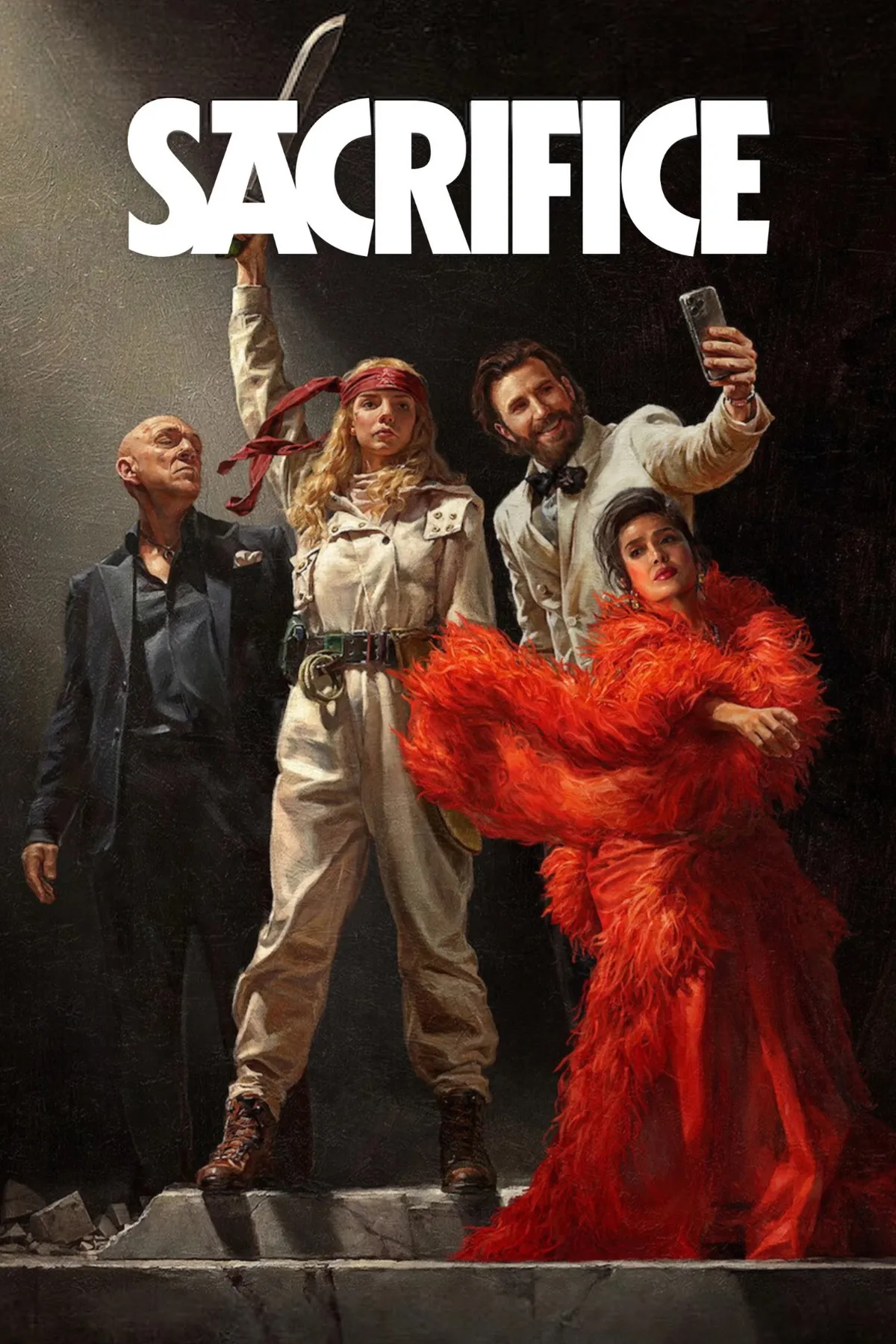
Sacrifice (2026)
- Cast: Chris Evans, Anya Taylor-Joy, Vincent Cassel, Salma Hayek, John Malkovich, Charli xcx, Yung Lean, Sam Richardson
- Director: Romain Gavras
- Genre: Action, Adventure, Comedy
- Runtime: 100 minutes
- Rated: NR
- Release Date: October 16, 2026
- Movies Like Sacrifice: Eddington, The End, No Other Choice, More Movies Like Sacrifice
- Follow us on Letterboxd