Margaret Qualley is one of the industry’s most underdiscussed stars, and yet one of its most versatile. Her range stretches from kooky Coen brothers leads (Drive-Away Dolls, Honey Don’t!) to reanimated corpses (Poor Things, and kinda The Substance?) to a young Manson family member in Once Upon a Time… in Hollywood. But she’s also proven herself to be an incredibly emotionally compelling leading lady, and Rachel Morrison’s delightful and surprisingly affecting Love of Your Life might be one of the better showcases of that side of her talent.
What’s surprising isn’t Qualley’s sincere, emotionally searching performance, or Morrison’s steady hand behind the camera, or even Julia Cox’s ability to capture the anxieties of finding and losing love in your late 20s and early 30s. It’s that this is the kind of movie that usually gets swallowed whole by the streaming ecosystem and turns out passive at best. The romance genre has increasingly become dominated by stiff literary adaptations featuring stars with questionable chemistry, scripts that don’t have the laughs or set pieces to justify their self-described rom-com status, or stories that lack the specificity to burrow into your brain and stick around for a few days afterward. Love of Your Life is a rare case that manages the third, occasionally resembles the first without actually being adapted from a novel, and finds little flashes of comedy without leaning on the rom-com label as a crutch. It’s simply a well-made adult drama about finding unexpected love, losing it, and trying to put the pieces of yourself back together while wondering whether you’ll ever be able to do it again.
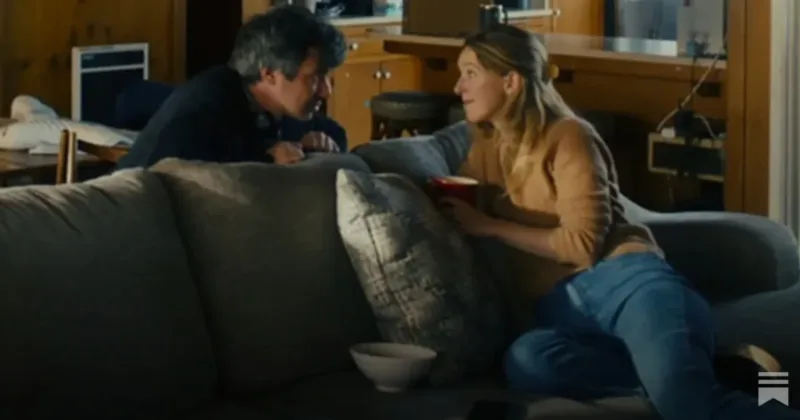
We experience this through Maya (Qualley), whose unusual upbringing in a broken family, absence of a father, and years spent living alone have made her particularly skilled at keeping other people at arm’s length. Love isn’t necessarily something she’s actively looking for, and she’s certainly not in a hurry to let anyone into her life. But a chance encounter while purchasing a dingy table through an online marketplace leads to an invitation from its former owner, Charlie (Gabriel Basso), and the two begin a relationship that unfolds with an easy, believable spontaneity. Over the first hour, we watch their awkward first-date conversations blossom into Maya meeting Charlie’s family, the two moving in together, and eventually a wedding hosted inside their own apartment. It’s a sweeping love story built out of the little things, with Maya gradually learning what it means to love someone else and, perhaps more importantly, to let herself be loved in return.
Qualley and Basso are both terrific at conveying the wholesome, quirky and sometimes awkward sides of their personalities, and the ways those qualities gradually settle into a relationship built on genuine affection and sacrifice. There’s a naturalness to their connection that makes the progression from strangers to partners feel entirely believable, never requiring some grand romantic gesture to convince us that these two belong together. The film understands that falling in love is often less about a single lightning-strike moment than a thousand little decisions to keep showing up for another person. It’s an emotionally generous first half, and one that sets an awfully high bar for everything that follows.
And then the film breaks your heart. Charlie has asthma, contracts a severe case of COVID, and finds himself caught in an overwhelmed Boston hospital system where beds are quickly filling up. By the time he’s admitted, it’s too late, and Maya is left saying goodbye over a FaceTime call. It’s a devastating sequence that hits all the harder because the movie has spent so much time allowing us to experience the life these two have built together. The loss doesn’t feel like a narrative contrivance designed to kick the story into gear; it feels like the sudden, incomprehensible interruption of a future that was only just beginning to take shape. Morrison and Cox have done the work of making us believe in this relationship, and that investment pays off in the most painful way possible.
The second half follows Maya as she runs away from that grief almost immediately, with the film jumping three years ahead to find her living in Lisbon and working in telehealth. She’s become even more withdrawn than she was before meeting Charlie, floating between bars and one-night stands that are deliberately designed not to go anywhere. But one night with Felix (Aaron Pierre), a charming and very muscular single father, proves difficult to leave behind. Maya keeps returning to him over the following days and nights, drawn to a man whose own romantic life is every bit as complicated as hers. Felix shares custody of his daughter and maintains an on-again, off-again relationship with the child’s mother, creating a family arrangement that is messy and unconventional but somehow comforting to Maya. Here, at least, is someone who understands that love doesn’t always fit into the tidy little boxes we might prefer.
Unfortunately, this is where Love of Your Life begins to lose some of the emotional momentum it built so effectively in its first hour. Maya and Felix never quite share the same connection that Maya and Charlie did, whether that’s a consequence of Qualley and Pierre’s so-so on-screen chemistry, an intentional choice in the script, or (more likely) some combination of the two. Their relationship is constructed around physical intimacy rather than emotional openness, and while that certainly makes sense for someone trying to avoid getting hurt again, it doesn’t make for the most compelling romantic dynamic to watch. I found myself wanting to feel more of a connection between these two, particularly because I’m such a fan of both actors, but the relationship never quite develops the depth necessary to make me believe in its long-term potential.
Pierre is charming, and the complications of Felix’s domestic life offer Maya an opportunity to see another version of adulthood that isn’t defined by conventional romantic milestones. But he struggles to meet the emotional openness that Qualley and Basso brought to the film’s earlier relationship, and the result is a second romance that feels comparatively thin. Maya’s growing discomfort with how close Felix remains to his daughter’s mother eventually pushes her to pull away before she gets too attached. It’s intentionally messy, and I appreciate that Morrison and Cox aren’t trying to manufacture a clean, easy rebound romance out of Maya’s grief. Still, I couldn’t always tell whether the emotional distance was the point or whether the film simply struggled to make this particular pairing work. Either way, the second half never quite reaches the heights of the first.
Thankfully, the film finds its footing again as Maya finally confronts Charlie’s death head-on, meeting with his mother for the first time since his passing. Catherine Keener makes a tremendous impression in her limited screen time, giving the film’s final stretch a sense of emotional clarity that it desperately needs. Their encounter becomes a moment of shared grief and hard-won closure, allowing Maya to acknowledge what she’s lost without treating that loss as something she must erase before she can move forward. There’s no miraculous cure for heartbreak here, no suggestion that finding another person will somehow make everything right. Instead, Maya begins to accept the life she’s been given, the hand she’s been dealt, and the possibility that choosing herself might be the first step toward loving someone else again.
Love of Your Life isn’t a perfect romance, and its uneven second half keeps it from becoming something truly special. But the best moments here are so good, and the performances range from great to at least genuinely interesting. Qualley continues to expand her range as a leading actress, finding another emotionally rich character in a film that asks her to move between romantic joy, devastating grief, and the uncomfortable space in between. Morrison, meanwhile, follows up 2024’s The Fire Inside with another emotionally well-pitched film, one that understands the messy realities of being a person trying to make sense of love and loss. There’s plenty to think about here, and even more to feel.
READ MORE MOVIE REVIEWS: Sacrifice, Late Fame, Animals
And I’ll twist the knife a little bit by saying that, as far as streaming romances go, this is far, far better than par for the course. It may not sustain the brilliance of its first half, but its best moments linger long after, and that’s more than I can say for most of the disposable romances that tend to populate these platforms.
Score: 7/10

Love of Your Life (2026)
- Cast: Margaret Qualley, Aaron Pierre, Patrick Schwarzenegger, Gabriel Basso, Catherine Keener
- Director: Rachel Morrison
- Genre: Drama, Romance
- Runtime: 109 minutes
- Rated: R
- Release Date: October 14, 2026
- Movies Like Love of Your Life: The Sun Never Sets, Mile End Kicks, Rye Lane, More Movies Like Love of Your Life
- Follow us on Letterboxd