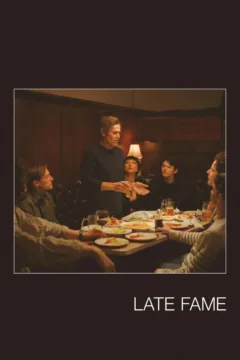
I’m still not entirely sure whether director Kent Jones sees a bit of himself in Ed Saxberger, or whether his Willem Dafoe-led Late Fame is more broadly an ode to the countless artists who never quite broke through into the mainstream of their respective mediums. Either way, it feels like a useful lens through which to view Jones’ latest feature, his first since 2018’s Diane. There’s a lot here about the self-serving inner circles of artists who prop one another up while quietly looking for their own paths to notoriety, and Jones finds enough uncomfortable truth in that dynamic to make this a worthwhile character study.
Saxberger has spent decades working at a post office, having long since abandoned the idea of making a living as a poet. He published a book of poetry in the 1970s that went largely unnoticed, took that as a sign to get out before the struggling artist’s life swallowed him whole, and settled into a modest existence of cheap beer, billiards, and the occasional social evening at a dive bar. But when a group of young, self-proclaimed intellectuals rediscover his work, Saxberger finds himself pulled back into a world he’d more or less given up on. Suddenly, he’s a figure worth looking up to, dispensing whatever wisdom he can muster to a generation of writers who see something in him that the rest of the world never did.
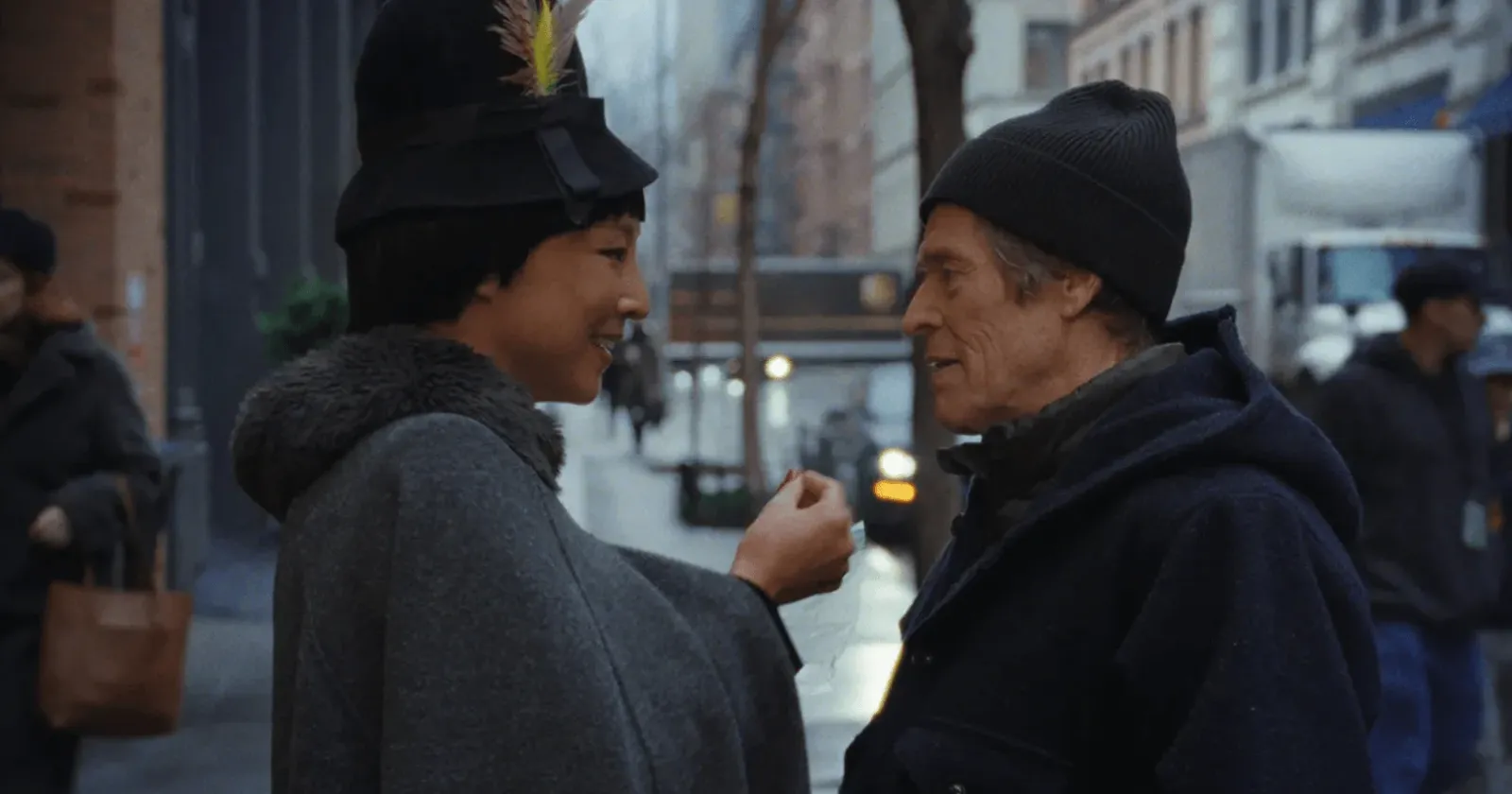
He’s not the only older artist orbiting this group, either. Among its few women is Gloria (Greta Lee), a flirtatious actress who catches Saxberger’s eye and offers him a glimpse of a life beyond the familiar routines he’s built for himself. The two never quite develop the romantic relationship Saxberger might hope for, but there’s an understanding between them that feels more meaningful than any conventional love story. They’re both at a point where time hasn’t necessarily run out, but it’s certainly running, and perhaps a little faster than either would like to admit.
That’s where Late Fame is at its best: in those moments when the promise of a second act collides with the realization that the first one may not have amounted to much in the first place. Dafoe’s Saxberger is briefly invigorated by the prospect of returning to writing, only to discover that revisiting an old passion doesn’t necessarily make it any more fruitful the second time around. Meanwhile, Lee delivers a wonderfully melancholic performance as a flapper-era singer, with the film’s climax bringing the two characters together for a reading hosted by the young writers’ association. There’s a genuine sadness to these sequences, a recognition that the desire to be seen and appreciated doesn’t disappear just because the years have passed. If anything, it becomes more difficult to ignore.
There are shades of Noah Baumbach throughout, owing partly to the Manhattan setting, with the on-location street photography giving the film a lived-in quality that I really appreciated. But the comparison extends beyond the geography. It’s easy to imagine Saxberger as a distant, older version of the characters in Kicking and Screaming or Frances Ha, with the youthful optimism worn away by decades of disappointment. Where those characters are still trying to figure out who they’re going to become, Saxberger is confronting the possibility that he’s already become the person he’ll always be. It’s a quietly devastating distinction, and one that Dafoe is particularly well suited to embody.
He’s about as perfectly cast as I can imagine for this role. There’s a weathered quality to his performance, the look of someone who’s made peace with the modest life he’s built but remains just curious enough to follow a potentially dead-end opportunity if it means feeling a spark again. He never turns Saxberger into a caricature of the failed artist, and that restraint makes the character’s gradual disillusionment all the more effective. A subplot involving his seriously ill brother, communicated largely through phone calls with his sister, initially feels somewhat disconnected from the main narrative. But it lands with considerable force in the film’s final third, just as Saxberger’s hopes for this newfound writing career begin to unravel. The possibility of artistic rediscovery becomes inseparable from the more painful reality of time passing, relationships fading, and the opportunities we don’t get back.
I’m less convinced by what Lee is doing here, or perhaps more accurately, by what the script gives her to work with. Her performance is fiery and deliberately theatrical, almost as if she’s wandered in from a different movie entirely, while Jones builds a more subdued, melancholic atmosphere that Dafoe fits into effortlessly. It’s not until Saxberger overhears a heated argument between Gloria and an unnamed man at her apartment building that the performance’s exaggerated exterior begins to give way to something more serious and considerably sadder. There’s clearly a more complicated person underneath that facade, but Jones never quite finds enough within Gloria’s character to explore it fully. Lee has moments that work, particularly when the film lets her melancholy come through, but the characterization never feels as cohesive as Saxberger’s, and the tonal mismatch can be distracting.
Still, the film saves some of its sharpest observations for the final stretch, when the romanticized idea of artistic community begins to look a lot more like a transaction. The best moment comes when Saxberger is asked by the youngest member of the writers’ group to read his work, only for the kid to reveal that he never actually read the poetry collection that supposedly made Saxberger worth celebrating in the first place. It’s a wonderfully acidic scene, cutting through all the intellectual posturing and mutual admiration to expose just how hollow these relationships can be. Saxberger isn’t being appreciated for the work he did; he’s being used as a convenient symbol by people who want to feel connected to something meaningful. The film gets genuinely nasty here, in a way that feels both painfully real and deeply satisfying.
Late Fame doesn’t quite reach the gut-punching heights of Inside Llewyn Davis or the aforementioned Baumbach films, but it fits comfortably within that same tradition of examining people whose ambitions have outlived their opportunities. There’s a difference between being a has-been and being someone who never was, and Jones seems keenly aware of how much more complicated the latter can be. The film isn’t always as sharp or tonally consistent as I’d like, particularly when it comes to Gloria, but Dafoe anchors it with another terrific leading performance, and the closing moments leave a bitter taste that feels entirely earned.
READ MORE MOVIE REVIEWS: Animals, The Social Reckoning, Matchbox the Movie
Jones hasn’t made many films in recent years, but I like the scale he’s working at here and the boots-on-the-ground approach he brings to the material. Late Fame is a modest film about modest lives, and while it occasionally struggles to find the right register, its best moments cut deep. Hopefully, Jones doesn’t make us wait another eight years for his next feature.
Score: 6/10
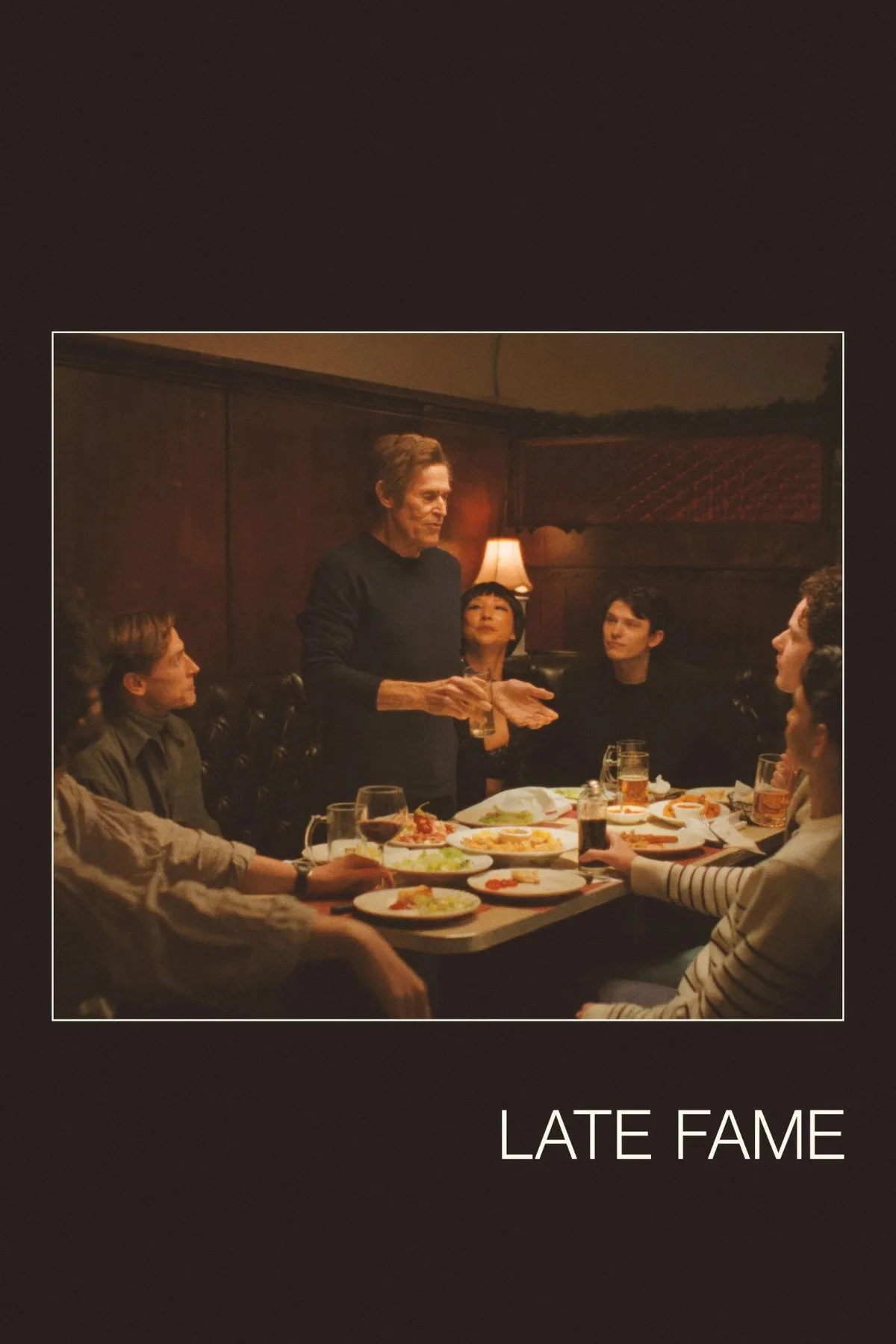
Late Fame (2026)
- Cast: Willem Dafoe, Greta Lee, Edmund Donovan
- Director: Kent Jones
- Genre: Drama
- Runtime: 97 minutes
- Rated: NR
- Release Date: August 7, 2026
- Movies Like Late Fame: The Christophers, A Poet, Mile End Kicks, More Movies Like Late Fame
- Follow us on Letterboxd