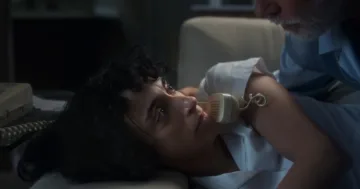
A sadly misconstructed and ultimately disappointing film from one of the great German filmmakers of the 21st century, Christian Petzold’s Miroirs No. 3 sticks to small-scale beauty centered around a female protagonist with enough central screen presence to make you feel as though the entire world revolves around her. Petzold usually enlists either Nina Hoss or Paula Beer for the honors. In the case of Miroirs No. 3, it’s Beer, playing Laura, a young music student who somehow survives a car crash that kills her boyfriend.
Framed initially as a story of recovery, Laura chooses to stay with the older woman who discovered the crash and took her in while paramedics arrived. Betty, played by Barbara Auer, lives a quiet life, one that feels contentious more in the things left unsaid than in the things spoken aloud between her, her husband Richard (Matthias Brandt), and their son Max (Enno Trebs). It’s slow and deliberate, shot beautifully by cinematographer Hans Fromm in rather isolated sets akin to a few of Petzold’s previous films, Afire and Barbara among them, where after a while you forget that anything else exists outside these closely constructed worlds.
The hours turn to days turn to weeks in which Laura stays with Betty and her family, without much explanation to the viewer. Only in a few off-hand comments from Max do we sense there’s more tension at play than just Laura being welcomed into this household. That is, until the film reveals her resemblance to the family’s daughter who died not long ago.
It’s at this point in the story, roughly an hour into an 86-minute film, that Miroirs No. 3 pivots away from Laura and toward the grieving process (or the lack thereof) of this family. Sticking through a movie that spends the strong majority of its runtime building one character only to shift its focus so dramatically in the final third is a genuinely confusing choice, and one that didn’t really work for me. Especially coming from a writer and director who has proven to be one of the great third act architects working today, either in a literal sense (Phoenix) or a metaphorical one (Afire). This just does surprisingly little with what it’s set up, and deviates from Beer’s character far more than anticipated in the final stretch.
The classical, stoic filmmaking from Petzold is still very much present, and often to genuinely insightful effect. Beer slots into the role of Laura perfectly, as she tends to do in his films. Despite being more of a central figure here than she was in Afire or a few of her other collaborations with Petzold, there’s a slipperiness to her character that still feels typical for what she does best in his work, and it functions well for the film’s first two thirds. Miroirs No. 3 marks their fourth collaboration, following Transit, Undine, and Afire, and the shorthand between actor and director is evident even when the material isn’t meeting them halfway.
READ MORE MOVIE REVIEWS: Hoppers, Nirvanna the Band the Show the Movie, Sirāt
The tepid critical response to Miroirs No. 3 feels more correct than I wanted it to. Petzold could make paint drying seem intermittently interesting, and there are stretches here where that holds true. But the loose ends didn’t come together into anything I felt satisfied by, or even something that felt fully earned by the story it was telling. It’s one of his weaker films, though he remains one of the greats, and even the greats swing and miss sometimes. That fact this disappoints is ultimately a reminder to how high the bar is when his name is attached.
Score: 5/10

Miroirs No. 3 (2026)
- Cast: Paula Beer, Barbara Auer, Matthias Brandt, Enno Trebs
- Director: Christian Petzold
- Genre: Drama
- Runtime: 86 minutes
- Rated: NR
- Release Date: March 20, 2026
- Movies Like Miroirs No. 3: The Love That Remains, Sentimental Value, Hamnet
- Follow us on Letterboxd