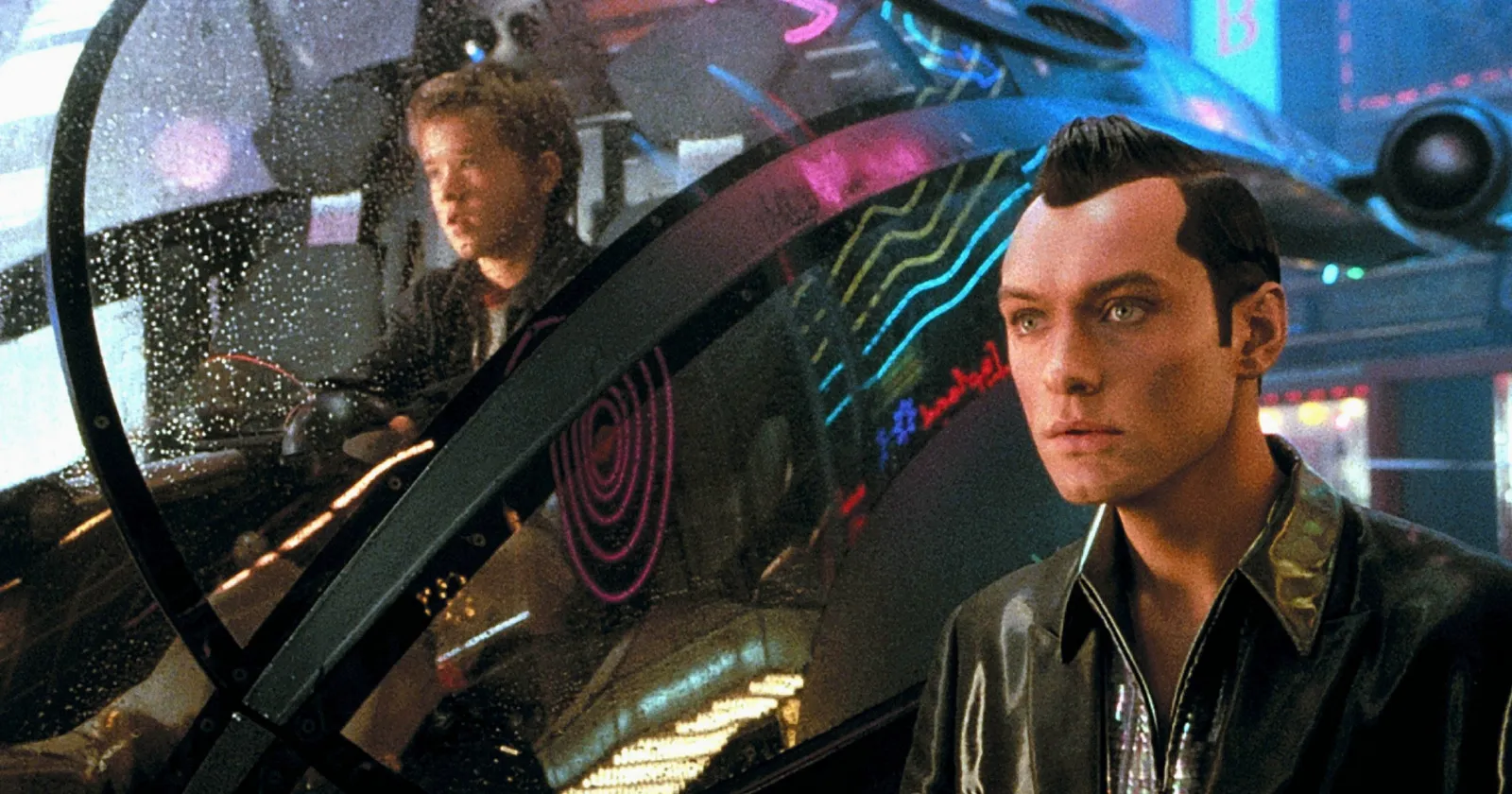
Steven Spielberg’s A.I. Artificial Intelligence is a towering science fiction epic, one jostling with personal trauma, grief, and existential anxiety about the end of the human race – all rolled together in a narrative so expansive compared to its contemporary turn-of-the-century sci-fi epics that it almost defies categorization. It’s a lot of movie. Most of it is simultaneously entertaining and thoughtful, and it genuinely looks remarkable, especially for its era.
It’s hard to tackle A.I. without discussing its different sections individually and how they make up one of the more engrossing and enriching watches of 2001, largely because Spielberg‘s script takes on a completely different scale and focus with each act. It starts personal and familial – a Cybertronics employee (Sam Robards) and his wife Monica (Frances O’Connor) agree to take on a test A.I. robot named David, played by Haley Joel Osment in an all-timer child performance, a robot built with the ability to love. Their biological son has been suspended in animation due to a rare disease, presumed never to wake. What Spielberg is really working through in these early stretches is the societal repercussion and emotional toll of essentially replacing your child with a robot to navigate – or neglect – grief. It’s messy and uncomfortable in the best way, and it’s the kind of thematic territory that most blockbuster filmmakers mostly ignore.
But their son does wake up, and after a series of dangerous interactions in which he attempts to frame David as unsafe, Monica is tasked with taking David to be shut down. She can’t go through with it. She drops him off roadside with other obsolete A.I. robots instead, and suddenly Spielberg has cracked the film wide open into something completely new. Still navigating the possibility of finding family, or some semblance of one – but now also a movie about the existential threat of humans building technology that rivals their own capabilities, how that corrodes already broken systems, and how it may directly or indirectly spell the end of a livable ecosystem entirely.
All of it is shot through the same beautiful, childlike wonder that defines so many of Spielberg’s classics. You feel as though you’re experiencing the world for the first time vicariously through David – the highs and the very bleak lows of human existence, filtered through a robotic child in expedited timeframe. That is until an immense time jump in the final thirty minutes takes the film somewhere I genuinely couldn’t believe it was going in the moment. It’s one of those swings that either lands or craters, and I’d argue Spielberg sticks it.
READ MORE MOVIE REVIEWS: Ghost of Mars, Ocean’s Eleven, Pulse
There’s 146 minutes packed inside this thing, and Spielberg fills nearly all of it with spectacle and food for thought. It does make me shake my head a little that the same director would make Ready Player One nearly twenty years later, a film that somehow represents a step backwards in the integration of practical and digital effects rather than forward. A.I. just looks so good, even now.
It may sit a slight notch below the masterpieces of his 70s, 80s, and 90s run – but only just. A.I. Artificial Intelligence is a major piece of filmmaking that’s going to keep aging like fine wine.
Score: 8/10
A.I. Artificial Intelligence (2001)
- Cast: Haley Joel Osment, Jude Law, Frances O’Connor, Sam Robards, Jake Thomas, William Hurt, Jack Angel, Robin Williams, Ben Kingsley, Meryl Streep, Chris Rock, Ken Leung
- Director: Steven Spielberg
- Genre: Adventure, Drama, Science Fiction
- Runtime: 146 minutes
- Rated: PG-13
- Release Date: June 29, 2001
- Movies Like A.I. Artificial Intelligence: Blade Runner 2049, WALL-E, Ex Machina, More Movies Like A.I. Artificial Intelligence
- Follow us on Letterboxd