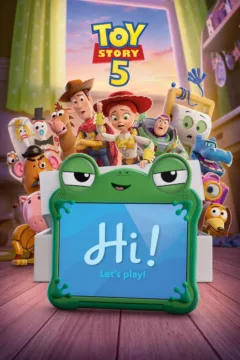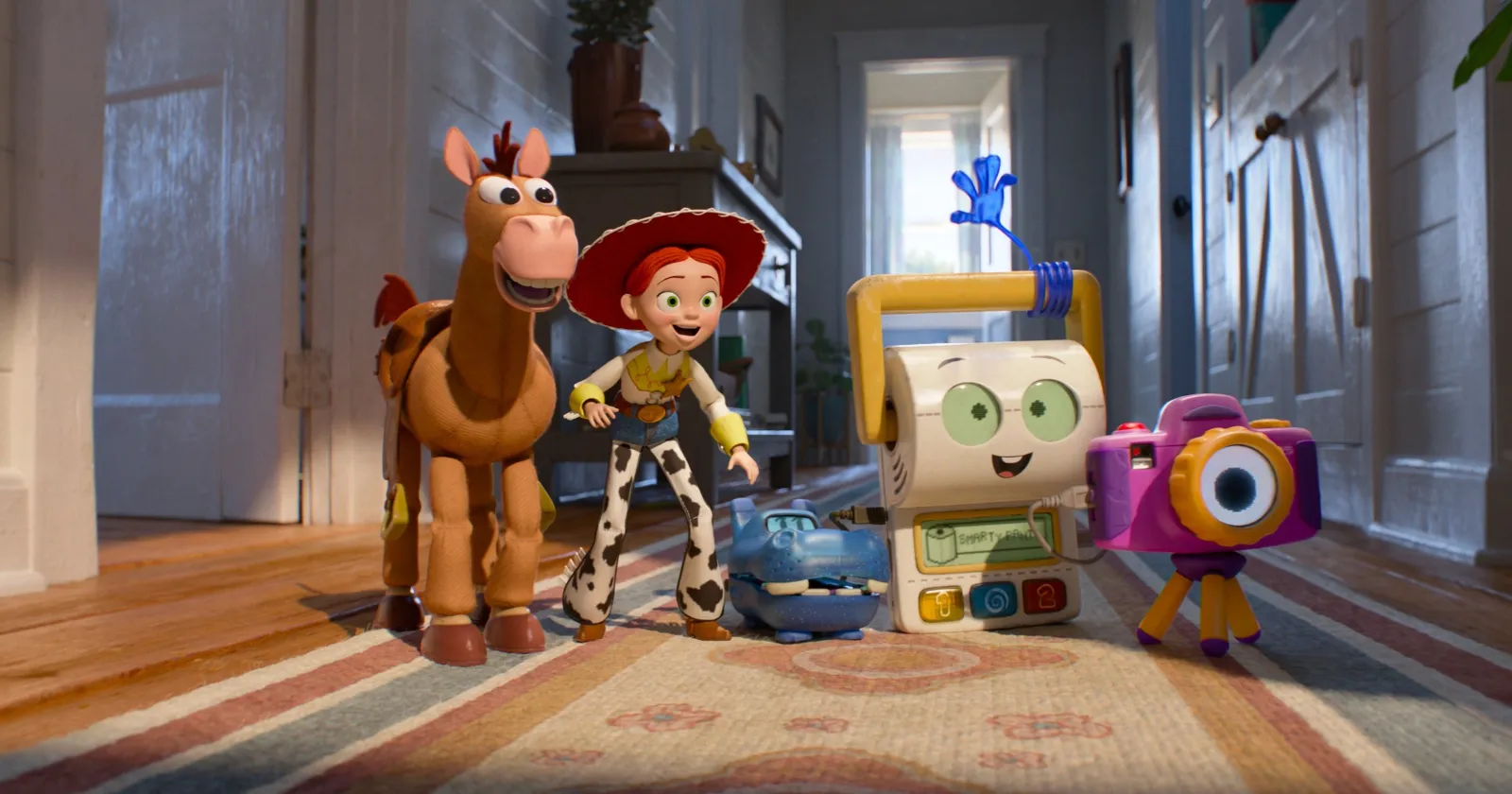
In its fifth installment, the Toy Story gang runs into an antagonist they probably never could have imagined would become an existential threat 30-plus years ago when Woody, Buzz, and the rest of the crew first met one another: technology. Through the franchise’s first four entries, the antagonists were almost always one of their own. Stuffed toys and dolls competing for relevance and notoriety from their owner, toys being kept in mint condition for the sake of valuation, or the looming threat of destruction, culminating in Toy Story 3’s arguably still-unmatched emotional wrecking ball of a finale. But Toy Story 5 reckons with the much more contemporary reality that toys may simply not be the dominant form of entertainment for 10-year-olds anymore. Learning pads, phones, screens, and other technology have emerged as a way for kids to funnel six to eight hours of their day, and one day you are your kid’s favorite toy and the next you are quite literally being swept under the bed.
In that regard, maybe Woody chose the right time to exit the child’s-play business and embrace the rogue, on-the-run life of a lost toy, hanging out with his long love interest Bo Peep following the devastating mutual parting between Woody and his longtime group of plush and plastic friends. Of course, that makes the decision to bring Woody back here feel a little more complicated. Toy Story 4 already felt like the definitive ending to the franchise (again) or at least the definitive ending to Woody’s involvement in it. Now the movie has to do a little bit of narrative shoehorning to get Tom Hanks’ character back into the fold, where he once again has to reassemble the team and help navigate a world in which kids are connected 24/7 through technology, along with the bullying, social pressures, and self-insecurities that come with always being plugged in.
READ MORE: Every Toy Story Movie Ranked
The biggest shift, though, is that Toy Story 5 is really more of a Jessie story than anyone else’s. She has essentially become the new Woody, and by Bonnie’s discretion, she is set to marry Buzz, making the series’ latest power couple. Naturally, the wedding gets put on hold once Lilypad, voiced by Greta Lee, enters the picture. She is Bonnie’s first real connection to the wider world of the internet, and initially seems like exactly what this new generation of kids needs: something that can teach and entertain simultaneously. But that same connection quickly becomes a beacon for the social isolation that comes with feeling different from everyone around you.
That is where I found myself liking Toy Story 5 more the longer I thought about it, even though I found it to be a somewhat tougher watch in real time. There are legitimately interesting ideas here about how technology changes childhood, how quickly social status can become important to kids, and how difficult it is to figure out how to connect with people who are either like you or completely unlike you. The problem is that the movie mostly scratches the surface of those ideas rather than really digging into them. Bonnie’s burgeoning understanding of online culture is observant of child behavior, but it rarely feels as though the movie is discovering anything particularly new about what it means to grow up in an always-connected world.
READ MORE: Every Pixar Movie Ranked
It also feels like another Toy Story movie about protecting the child you grow up with while quietly acknowledging that those days inevitably don’t last forever. That has always been the emotional engine of this franchise, and there is something both comforting and frustrating about watching Pixar keep returning to the same realization. Childhood ends. Kids move on. Toys get left behind. The series has spent five movies figuring out different ways to say that, but the more installments we get, the more difficult it becomes to make that revelation feel consequential.
Jessie’s storyline comes closest to doing that. A huge part of the movie involves her returning to her old stomping grounds from when she belonged to Emily and finally finding some closure with that chapter of her toy-life. When I saw where the story was going, I immediately expected Emily to be the mother of the young girl living on the ranch, and I essentially prepared myself for the emotional devastation that I assumed was coming in the final 30 minutes. Instead, it is a completely new family living there, and Jessie finds her closure through a tribute at the foot of her favorite tire swing on the tree outside their yard. It lands, and I liked what the movie was doing with it, but I had already mentally prepared myself for something that was going to absolutely destroy me. The actual resolution is sweet rather than devastating.
That feeling extends to Woody’s return. I understand why Pixar wants him here, especially because the movie needs a recognizable bridge between the old Toy Story and this new technological threat, but bringing him back after the emotional writing-out of his character in Toy Story 4 undercuts some of what made that ending work. It is difficult to give a character a definitive farewell when the franchise keeps finding another reason for him to come back. And that is probably why the fourth and fifth entries have felt less consequential to me than the original trilogy. Toy Story 3, Toy Story 4, and Toy Story 5 have all managed to tie themselves up into increasingly tidy little bows, only for the next movie to undo that knot and tie it up again.
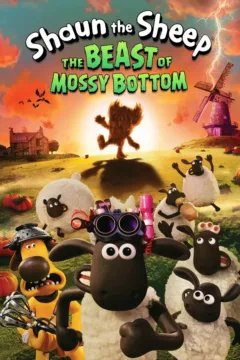
READ MORE MOVIE REVIEWS: Shaun the Sheep: The Beast of Mossy Bottom, The Mandalorian and Grogu, Mayday
That doesn’t make Toy Story 5 a bad movie. Far from it. Andrew Stanton is about as far from a newbie for Pixar as you could possibly get, and he gives this thing the steady, known-capable hand you would expect. There is plenty of charm, the characters still work, the animation is obviously terrific, and the central ideas are at least relevant to the world children are actually growing up in now. And if making another Toy Story is what allows Pixar to fund and experiment with original ideas like Luca, Elemental, and the upcoming Gatto, then I suppose we could do a lot worse.
But there is something increasingly strange about a franchise where the dead never truly dies, and every definitive ending is followed by another adventure that requires us to pretend the previous ending wasn’t quite as definitive as we thought. Maybe that is the inevitable curse of being a beloved animated franchise that Pixar knows audiences will keep showing up for. As long as they keep Mr. Pricklepants in our lives for just a little longer, I guess I can live with it.
Score: 6/10
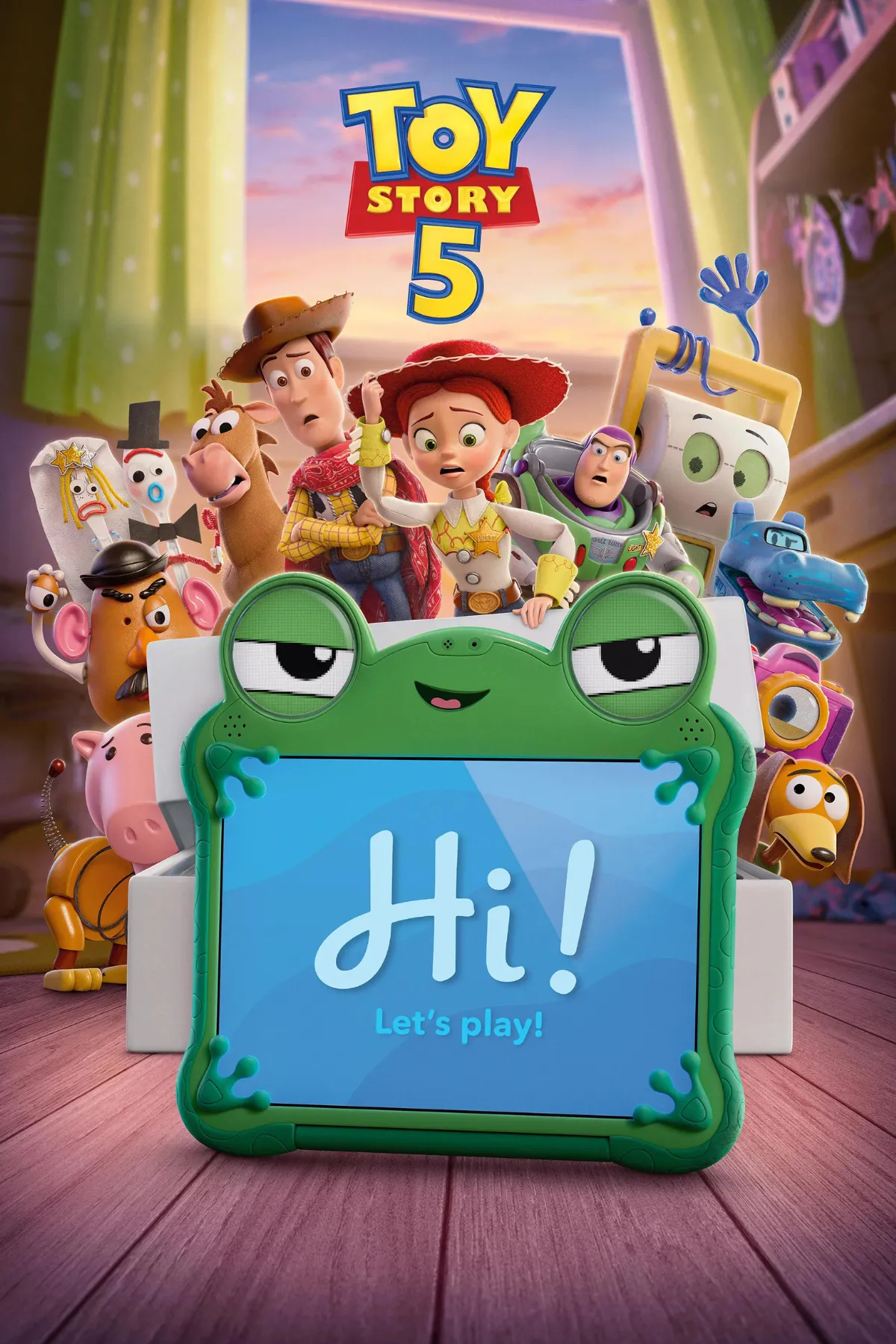
Toy Story 5 (2026)
- Voice Cast: Joan Cusack, Tom Hanks, Tim Allen, Conan O’Brien, Scarlett Spears, Greta Lee, Shelby Rabara, Mykal-Michelle Harris, Craig Robinson, John Ratzenberger, Keanu Reeves
- Director: Andrew Stanton
- Genre: Adventure, Animation, Comedy, Family
- Runtime: 102 minutes
- Rated: PG
- Release Date: June 19, 2026
- Movies Like Toy Story 5: Hoppers, Minions & Monsters, Elio
- Follow us on Letterboxd